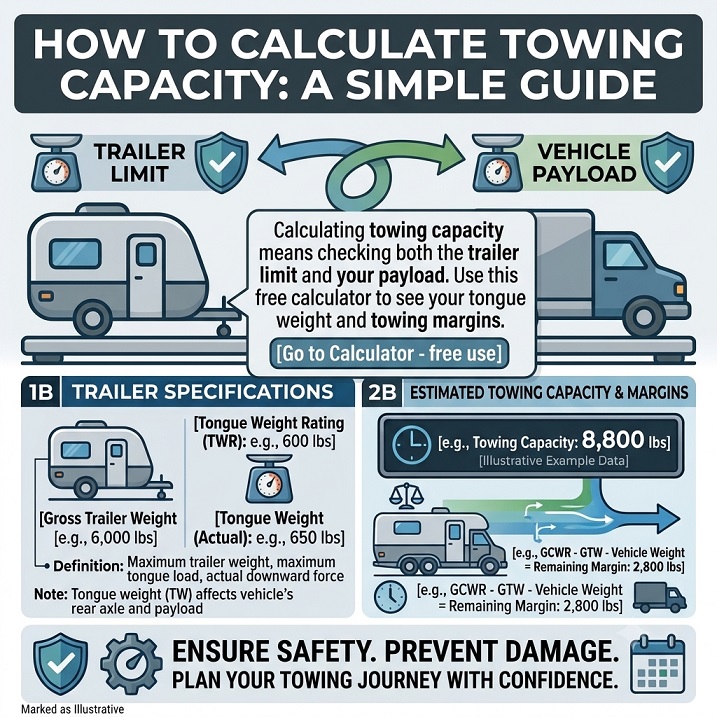
Hooking up a trailer can look easy. Making sure the whole setup is within the limits of your vehicle is where people make mistakes. Calculating towing capacity is not only about the number in the brochure. The weight on the hitch also eats into your payload, and your passengers and cargo count too.
This page explains the terms in plain language and gives you a calculator that checks both limits at once.
Towing Capacity, Payload and Tongue Weight in Plain Words
Three numbers matter most, and people often mix them up.
- Max towing capacity is the heaviest trailer your vehicle is rated to pull. If you are searching for the max towing capacity of a vehicle, this is the figure you want.
- Payload capacity is how much weight the vehicle itself can carry, including passengers, cargo, accessories and the weight pushing down on the hitch.
- Tongue weight is the downward force a trailer puts on the hitch. A common rule of thumb is that it should be a modest share of the loaded trailer weight, which is why the calculator offers ratios of 10, 12 and 15 percent.
The key idea: tongue weight counts as payload. That means a vehicle can be within its towing rating and still be over its payload rating.
Other Ratings You Should Know About
The calculator focuses on towing capacity and payload, but your manufacturer may publish other limits too:
- GVWR: the maximum weight of the vehicle itself when fully loaded.
- GCWR: the maximum combined weight of the vehicle and the trailer together.
- GAWR: the maximum weight each axle can carry.
- Hitch and receiver rating: the limit of the hitch hardware, which can be lower than the vehicle’s tow rating.
Your setup has to respect every one of these, not only one. That is why the calculator carries a reminder to check your manual.
Try the Towing Capacity and Trailer Weight Calculator
Enter your vehicle’s ratings and the real, loaded weight of your trailer. You can switch between pounds and kilograms, and choose a tongue weight ratio.
The result shows whether you are within the entered limits for both towing and payload.
- Max towing capacity: the number from your vehicle’s documentation.
- Vehicle payload capacity: how much weight the vehicle can carry.
- Loaded trailer weight (actual): the real weight of the trailer with its load, not an empty weight.
- Passengers, cargo and accessories: everyone and everything in the vehicle, including a hitch and a bike rack.
- Tongue weight ratio: the share of the trailer weight resting on the hitch.
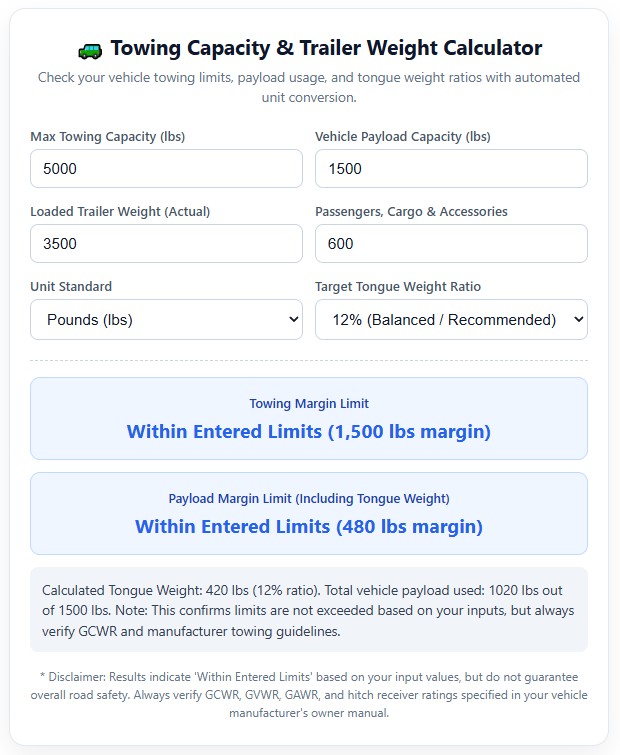
🚙 Towing Capacity & Trailer Weight Calculator
Check your vehicle towing limits, payload usage, and tongue weight ratios with automated unit conversion.
Example: A 3,500 lb Trailer With a 5,000 lb Rating
The calculator opens with a vehicle rated to tow 5,000 lb, a payload capacity of 1,500 lb, a 3,500 lb loaded trailer, 600 lb of passengers and cargo and a 12 percent tongue weight ratio.
With those numbers:
- The tongue weight is about 420 lb.
- The payload used is about 1,020 lb, which is the 600 lb of people and cargo plus the 420 lb on the hitch.
- The towing margin is 1,500 lb and the payload margin is 480 lb.
Both are within the entered limits. Notice how the payload margin is much smaller than the towing margin, even though the trailer is well under the tow rating.
How the Result Changes With Trailer Weight
Here is the same vehicle with the same 600 lb of passengers and cargo, a 12 percent ratio and different trailer weights:
| Loaded trailer | Tongue weight | Towing margin | Payload margin |
|---|---|---|---|
| 3,000 lb | 360 lb | 2,000 lb | 540 lb |
| 3,500 lb | 420 lb | 1,500 lb | 480 lb |
| 4,000 lb | 480 lb | 1,000 lb | 420 lb |
| 4,500 lb | 540 lb | 500 lb | 360 lb |
| 5,000 lb | 600 lb | 0 lb | 300 lb |
| 5,200 lb | 624 lb | over by 200 lb | 276 lb |
At 5,200 lb the calculator flags the towing limit as overweight. A heavier trailer also adds to the weight on the hitch, so the payload margin shrinks as the trailer grows.
Why Payload Often Runs Out First
The next example is one many people overlook. Keep the 3,500 lb trailer, but load the vehicle with 1,000 lb of passengers and cargo and choose a 15 percent tongue weight ratio:
- The tongue weight is about 525 lb.
- The payload used is about 1,525 lb, which is above the 1,500 lb payload capacity.
- The towing limit is still fine, with a 1,500 lb margin, but the payload result is overweight by 25 lb.
A trailer that is comfortably under the towing rating can still put a vehicle over its payload rating once people, gear and hitch weight are added. This is worth checking before every trip.
Choosing a Tongue Weight Ratio
The three options in the calculator describe different amounts of weight on the hitch:
- 10 percent: the lowest of the choices.
- 12 percent: a balanced middle setting and the calculator’s default.
- 15 percent: more weight toward the front, which is often associated with a steadier trailer, but it also uses more of your payload.
Hitches and receivers can also list a tongue weight capacity, so make sure yours can carry the weight you expect. You can find a trailer’s actual tongue weight by checking the trailer’s documentation or by measuring it with a tongue weight scale. Use a measured figure over an estimate whenever you can.
Where to Find Your Numbers
Always use the manufacturer’s figures for your exact vehicle, because ratings vary by model, engine, equipment and sometimes the year.
- Owner’s manual: the best source for towing ratings, GCWR and hitch information.
- Vehicle placard: many vehicles have a label in the door frame listing weight limits. Check what it says about payload.
- Trailer label: the trailer should list its own weight ratings.
- The real weight: if you can, weigh the loaded trailer rather than trusting a brochure number.
A Quick Checklist for Calculating Towing Capacity Before You Tow
- Write down the towing, payload, GCWR and hitch ratings for your vehicle.
- Use the loaded weight of the trailer, not the empty weight.
- Add everyone and everything in the vehicle, including accessories.
- Run the numbers with a realistic tongue weight ratio.
- Leave yourself a margin rather than aiming for the exact limit.
- Confirm the final setup against your manual.
More Calculators for Your Car
If you like checking numbers before you act, you might also try our tire size calculator, the wheel spacer offset calculator or the tire DOT code calculator.
A Note on What This Article Is Based On
To keep this honest: the example figures come straight from the calculator’s own logic and its starting values.
The explanations of towing capacity, payload, tongue weight, GVWR, GCWR and GAWR are general knowledge, not a claim about any particular vehicle or trailer. This is not safety or legal advice, and the calculator cannot guarantee that a setup is safe on the road.
Always follow your vehicle manufacturer’s instructions and your local rules. We have not used personal experience on this topic and we do not quote prices.
Frequently Asked Questions
1. How do I calculate towing capacity?
Start with your vehicle’s rated towing capacity and compare it with the loaded trailer weight. Then check payload too, because the tongue weight and your passengers and cargo count against it. The calculator on this page does both comparisons.
2. Where do I find the towing capacity of my car?
The owner’s manual is the best place. Some vehicles also list weight limits on a label in the door frame. Use the numbers for your exact model and equipment.
3. What is tongue weight?
It is the downward weight a trailer puts on the hitch. The calculator estimates it as a percentage of the loaded trailer weight and counts it toward your payload.
4. Can I be under my towing capacity and still overloaded?
Yes. The payload rating is a separate limit. A trailer within the towing rating can still push a vehicle over its payload rating, especially with heavy passengers and cargo.
5. Does a result of “Within Entered Limits” mean it is safe to tow?
No. It only means the numbers you entered are within the limits you entered. You still need to check GCWR, GVWR, axle ratings, the hitch rating and your manufacturer’s guidance.
※ LICENSE & TERMS OF USE
- Personal Use Only: This vector file is provided strictly for personal DIY projects and non-commercial purposes.
- Modification Allowed: You are free to edit, resize, or modify this file for your own personal use.
- No Commercial Sale: Mass production, selling physical items made with this file, or any commercial exploitation is strictly prohibited.
- No Redistribution: You may not re-upload, share, or resell the digital files (SVG/AI) on any other platform.
DISCLAIMER
This file is provided "AS IS" without warranties of any kind. DVG (Detail Vector Garage) assumes no responsibility or liability for any trademark, copyright, or legal issues arising from the use of this file.